

Generic CRM vs Real Estate Sales Software: what do you actually need?
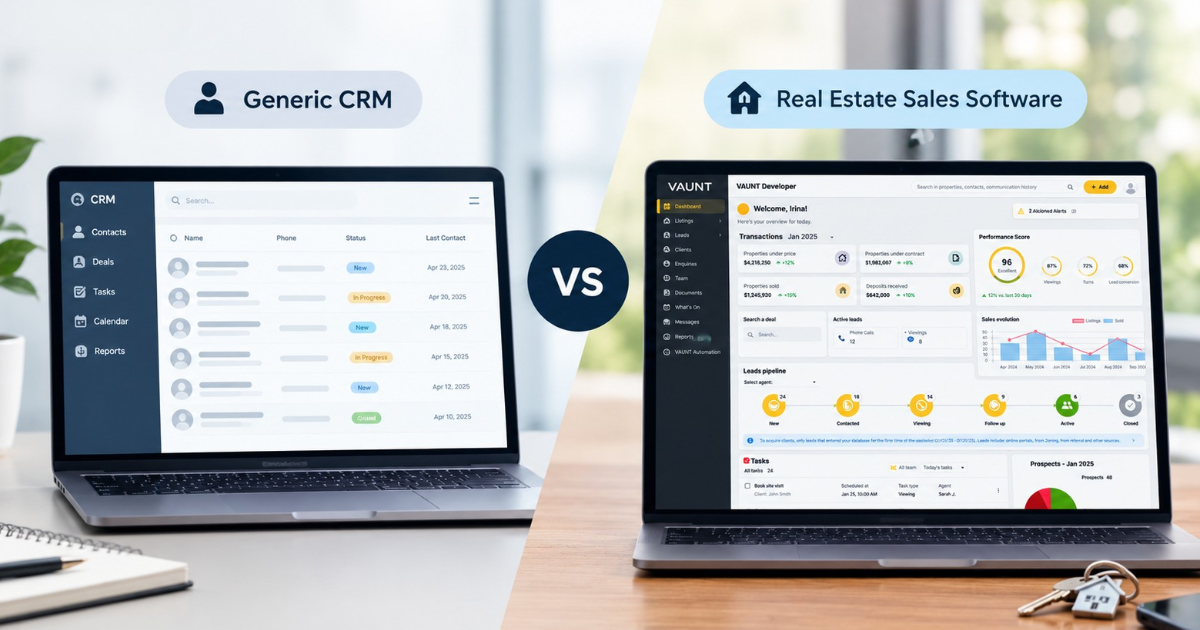
A generic CRM can help a sales team store contacts, track activity, and keep follow-ups from falling through the cracks. But residential real estate sales and leasing involve much more than managing names in a database: teams need to track unit availability, coordinate tours, qualify leads, manage broker relationships, measure marketing performance, and move prospects toward a signed lease or sales contract. That is where purpose-built real estate sales software can offer a more complete solution than a traditional CRM.
What is the real difference between a generic CRM and real estate sales software?
The real difference is context. A generic CRM is designed to support many types of businesses, so its structure is flexible but broad. Real estate sales software is designed around property-specific workflows, helping developers, leasing teams, and sales agents manage the relationship between prospective buyers or renters and available units.
A generic system may work well if your process is simple: add a lead, assign a salesperson, schedule a call, and mark the deal as won or lost. But real estate creates more moving parts. A prospect may inquire about several apartments, compare floor plans, ask about pricing, schedule a tour, pause while arranging financing, and return through an Instagram ad weeks later.
Generic CRM systems are useful, but limited
A fair comparison starts by recognizing that generic CRMs have real value. They can replace scattered spreadsheets, centralize communication history, and help managers see whether their teams are following up. For businesses with simple pipelines and limited product complexity, those basics may be enough.
Typical CRM features include:
- Contact and lead records for storing names, emails, phone numbers, and notes.
- Pipeline stages to show where a prospect sits in the sales process.
- Task reminders for calls, meetings, and follow-ups.
- Email and message logging to review previous conversations.
- Basic reporting on activity, lead status, and conversions.
- User permissions to organize salespeople, managers, and administrators.
These features are useful, but they do not cover the entire real estate sales process. A generic CRM often treats every lead and product in roughly the same way. That creates friction when the product is a specific apartment, condo, new development, or portfolio with constantly changing availability and pricing.
The challenge is not that generic CRMs are bad. It is that they may require extensive customization to accommodate real estate workflows. Teams can end up maintaining extra spreadsheets, manually updating unit information, and relying on separate tools to coordinate tours, follow-ups, and reporting.
Real estate sales need more than contact management
Real estate selling and leasing are visual, relationship-driven, and timing-sensitive. Prospects evaluate location, lifestyle, budget, availability, move-in date, financing, and trust before making a decision. Sales and leasing teams need technology that supports these considerations instead of reducing every interaction to a single deal stage.
Purpose-built real estate software can connect buyer or renter demand with property inventory, marketing activity, team performance, and post-sale communication. For example, VAUNT offers specific tools for managing availability, automating follow-ups, creating interactive building tours, and tracking performance across projects.
A salesperson or leasing agent may need to know:
- Which properties or units match a buyer’s requirements.
- Whether a specific option is still available.
- How a lead first entered the funnel.
- Which campaigns are generating serious buyer intent.
- Which prospects need urgent follow-up based on behavior or timing.
- How the wider sales team is performing across projects or listings.
A generic CRM may store some of this information with custom fields and integrations. The difference is whether the system connects those details to the team's day-to-day leasing and sales workflow. For a team managing a 200-unit apartment building in Jersey City during lease-up, that can mean less time reconciling spreadsheets and more time responding to prospects, scheduling tours, and converting qualified leads.
Where does VAUNT outperform a generic CRM?
VAUNT is particularly relevant when a real estate team needs property-specific context, faster follow-up, and visibility into conversion performance rather than basic contact management alone.
A generic CRM can show that a lead exists. A real estate sales platform can connect that lead to a unit, a scheduled tour, a marketing source, and the next step in the sales process.
The difference becomes clearer as operations grow more complex. Consider a condo development in Miami preparing for sell-out, with several agents handling inquiries from website forms, Instagram campaigns, and broker referrals. The team needs to understand not only how many leads came in, but which units prospects are interested in, which sources generate serious buyers, and where deals are stalling.
VAUNT's lead management, unit availability, AI-powered follow-up, and project-level reporting help connect these activities. Managers can evaluate results across the pipeline instead of relying exclusively on manual updates and separate spreadsheets.
More than 90 developers use the platform across 75,000+ units. One of our clients closed up to 25% more deals with AI Profiling.
For managers, the value is greater visibility into the sales process. For agents, it is easier access to relevant information and less repetitive administration.
The cost of choosing a tool that is too generic
The wrong system rarely fails all at once. It creates small daily inefficiencies that gradually become expensive. Salespeople spend extra time updating fields, managers chase missing information, marketing teams struggle to connect campaign spending with signed leases, and prospects receive slower or less relevant follow-up.
These problems can affect performance even when the CRM itself is functioning properly. A system can be organized and still fail to help a team identify the best next action.
Common signs that a generic CRM is holding a real estate team back include:
- Too many manual workarounds. If your team needs spreadsheets, side documents, or repeated manual updates to manage property details, the CRM is not carrying enough of the process.
- Poor visibility into buyer intent. If salespeople cannot easily tell which prospects are most engaged or best matched, opportunities may be missed.
- Disconnected sales and marketing data. If lead source, campaign performance, and sales progress are hard to connect, budget decisions become guesswork.
- Low adoption from the sales team. If the tool feels like administration instead of support, people will update it late, inconsistently, or only when asked.
- Limited real estate context. If everything must be translated into generic fields, the system is not reflecting how property sales actually happen.
When a generic CRM may still be enough
A generic CRM may be enough for a very small team with a simple process, limited listings, and no need for deeper sales intelligence. If you only need a shared contact list, simple reminders, and a basic pipeline, a broad system can be a reasonable starting point. It may also work temporarily for teams that are still defining their sales process.
But “enough for now” is not always enough for growth. As soon as your team needs better lead prioritization, stronger property context, clearer reporting, or more coordinated sales activity, the limitations become harder to ignore. Moving to a residential real estate solution can prevent your sales process from becoming trapped inside a tool that was never designed for your market.
The decision should be based on the complexity of your sales environment. If your team sells real estate professionally and needs to improve conversion, responsiveness, and visibility, purpose-built software is usually the smarter foundation.
How to choose what you actually need
The best choice is not about buying the most complicated tool. It is about choosing the system that matches the way your team sells. A strong CRM comparison should focus less on feature lists in isolation and more on whether those features help your team act faster, serve buyers better, and manage the full sales cycle with confidence.
Use this checklist when evaluating generic CRM vs real estate sales software:
- Map your real sales workflow. Write down how a lead moves from first inquiry to decision, including every handoff, follow-up, and property-specific step.
- Identify where time is lost. Look for repeated manual updates, duplicate data entry, missed follow-ups, or unclear ownership.
- Review your buyer data needs. Consider whether your team can easily understand preferences, intent, source, and readiness.
- Check property-specific requirements. Ask whether the system supports the details your team needs to sell real estate effectively.
- Evaluate management visibility. Make sure leaders can see performance clearly enough to coach, forecast, and improve decisions.
- Consider future growth. Choose software that can support a more sophisticated sales process, not just today’s minimum needs.
Choosing the right software for your real estate team
A generic CRM can be a practical choice for teams that primarily need to organize contacts, track conversations, and manage follow-ups. However, as real estate operations become more complex, requirements such as unit availability, property-specific lead management, tour coordination, and project-level reporting may call for more specialized tools.
The right choice depends on your team's size, sales process, and operational needs. Before deciding between a generic CRM and real estate sales software, consider where your current workflow creates the most friction, which tasks could benefit from automation, and how easily your team can connect lead activity with sales outcomes.
For teams managing multiple properties or large residential developments, a purpose-built platform such as VAUNT are worth evaluating alongside a traditional CRM. Comparing the available features against your actual requirements can help you determine which solution offers the right balance of functionality, usability, and room to grow.





© 2026 VAUNT 102 INC 169 Madison Ave STE 2725 New York, NY 10016 US